

Source CMS
Source CMS
Launch fast, scale far, own no infrastructure
A fully managed CMS: Acquia runs, updates, and hosts it for you. Your work is what differentiates a site: the components, the frontend, the integrations. All of it lives in your own git repository.
What you can do with it
One content backend, and every way of putting it in front of people stays open.
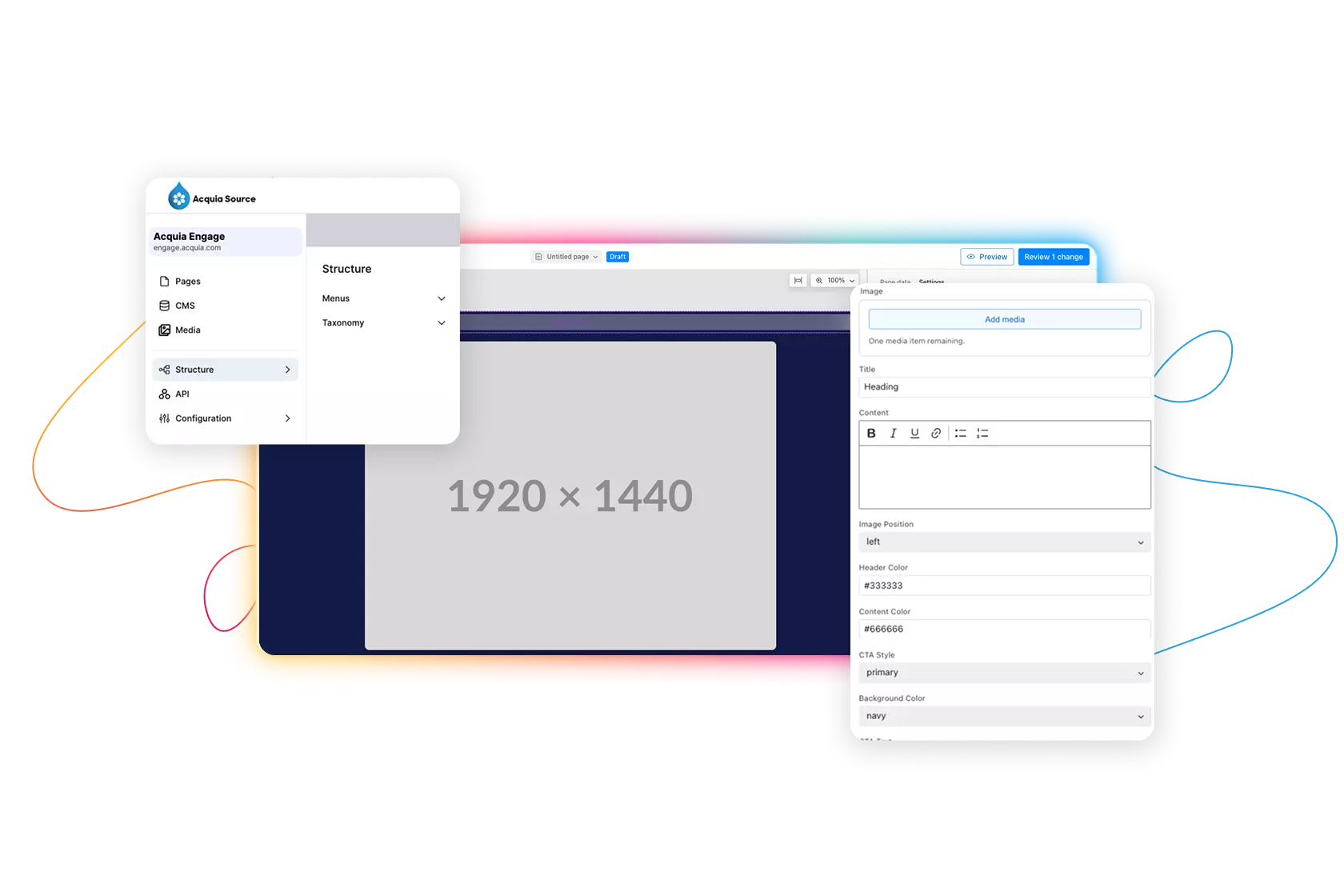
- Let editors ship pages fastAuthors compose pages visually from components your team writes; nothing sits in a ticket queue between a finished component and a published page.
- Serve content to any channelThe same content feeds your website, a mobile app, or anything that can call a URL, over an open standard rather than a proprietary export.
- Bring your own frontendGo headless when a project needs it: build the frontend in Next.js, Astro, Nuxt, or TanStack Start, reading the same content, with credentials kept off the browser.
- Put AI agents to workConnect an MCP-compatible agent (Claude Code, Cursor, and others) to your site’s content and tools. It works inside the access you grant. Experimental today.
Where you are coming from
Wherever you are coming from, each move keeps what already works and adds what was missing. Content comes out over an open standard, and agents connect over an open protocol.
- Coming from a traditional CMSYou keep the visual editing your authors rely on.You add components that are real code in your git repository, and content any app can read from day one, over an open standard.
- Coming from a headless-only CMSYou keep the API-first content, still over an open standard.You add a rendered site out of the box, and visual editing that survives going headless instead of a backend that only ever serves JSON.
- Coming from self-managed DrupalYou keep Drupal’s content model and its editorial depth: nothing to start over.You hand the hosting, updates, and operating to Acquia, and your work moves up the stack.
- Coming from prompt-to-app AI buildersYou keep building at agent speed.You add what a one-off app lacks: structured content, roles and review workflows, and agents that act through an open protocol, inside the access you grant.
Questions developers ask
Is it Drupal underneath?
Yes. The content types, the roles, the review workflow, and the revisions are Drupal’s, and every content type has an API endpoint. Acquia runs the hosting and the updates.
Can I go headless later?
Yes. A site renders one way at a time, so going headless turns in-platform rendering off, and editors keep composing pages from your components while your app does the rendering.
Can I connect an app I already have?
Yes. Instead of scaffolding a new project, you install the same SDK and your framework’s adapter in the app you have, and it reaches the same registered state.
How do API requests authenticate?
With OAuth 2.0 access tokens. You add an API client in the site’s admin interface and grant it a scope; your server exchanges its credentials for a token, so the credentials stay off the browser.
How do I know when content changes?
The site calls URLs you register whenever content changes, sending the changed entry itself, and retries five times if your endpoint is unreachable.
How much access does an AI agent get?
Only what you grant. The MCP server is off by default and you enable it per site; each agent then works inside the scopes you grant, on tokens that expire in five minutes, and you can revoke its access at any time. Experimental today.
Start building
01 first. After that, 02 and 03 are independent.